

Gasoline/petrol
Perhaps the most dangerous of the liquid fuels traded via fuel forecourts is gasoline/petrol.
Gasoline/petrol is a highly flammable liquid than can emit vapour even at very low temperatures.
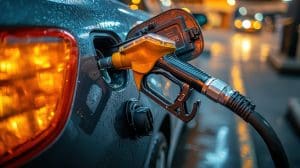
Risks
Where this fuel is being dispensed, there will always be a risk of explosion if a source of ignition is present. Being less dense than water, gasoline/petrol can form a slick upon its surface, so in wet conditions there is still a risk of explosion near to or around its original point of exit. Its vapour also does not disperse easily and is denser than air. It will therefore tend to sink and form invisible puddles, collecting in drains, pits, bunded areas or enclosures where there is little air movement. In sufficient concentration above the lower explosive limit and in the presence of a source of ignition, the collected vapour will explode.
LPG/LNG
For fuel forecourts dispensing liquefied petroleum gas (LPG or Autogas) or liquefied natural gas (LNG), further explosive atmosphere risks are present. LPG is essentially liquefied butane or propane while LNG is methane or natural gas. These products typically have an odorant added to aid leak detection and they will quickly evaporate at ambient temperature and pressure. Methane vapour is lighter than air and therefore will tend to disperse. LPG vapour is denser than air and therefore carries similar risks of accumulation to gasoline/petrol.
In addition to current automotive fuels, fuel forecourt operators may also wish to develop competence in the explosive atmosphere risk of future fuels, such as the hydrogen gas used by fuel cell powered vehicles.